
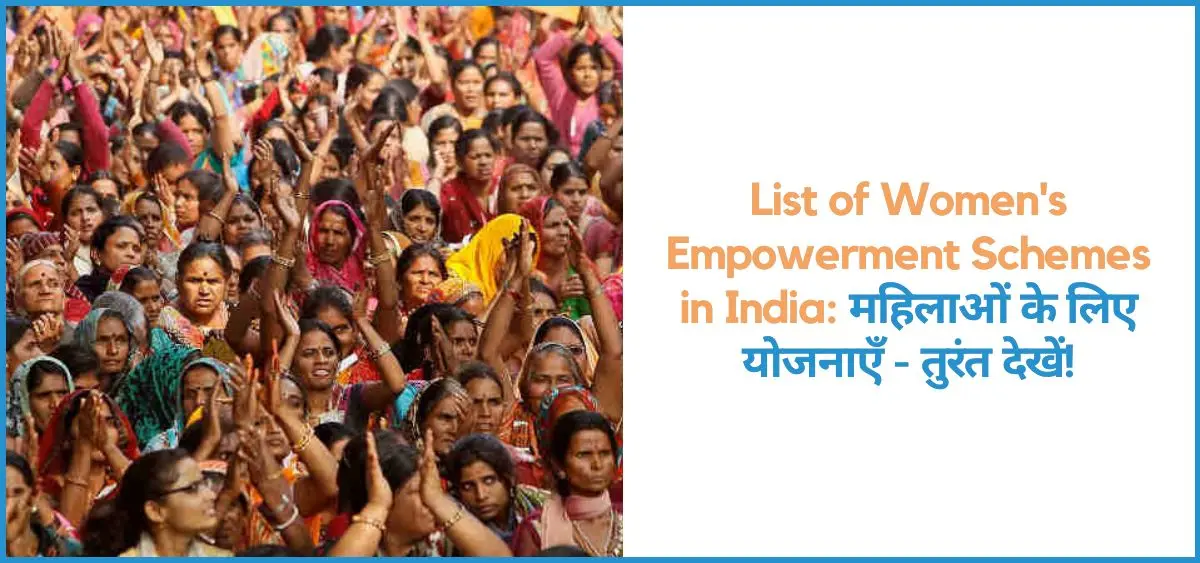
50+ Government Women’s Welfare Schemes – Which Ones Can You Get for Free? | List of Women’s Empowerment Schemes in India | Government Schemes for Women’s Empowerment in India | Women’s Empowerment Programs in India
Women in India are progressing rapidly, and to strengthen this transformation, the government has launched several impactful initiatives. If you want to know which schemes are truly bringing about change in women’s lives, then this List of Women’s Empowerment Schemes in India is extremely important for you. From economic independence to education, safety, and health—the scope of these schemes is continuously expanding. You’ll be amazed to learn how schemes like Mission Shakti, Beti Bachao Beti Padhao, Sukanya Samriddhi Yojana, and Ujjwala Yojana work. Read on for complete information!

1. Sukanya Samriddhi Yojana (SSY)
Launched: January 22, 2015, by Prime Minister Narendra Modi under the ‘Beti Bachao, Beti Padhao’ campaign
Ministry: Ministry of Finance / Ministry of Women and Child Development
Objective
- To create a fund for the education and higher education expenses of girl children.
- To provide financial security for the marriage of daughters.
- To improve the gender ratio and bring a positive change in social attitudes towards girl children.
- To make daughters economically self-reliant (Empowered).
Benefits
- High Interest Rate: Currently an attractive interest rate of 8.2% (revised periodically).
- Tax Benefit: Exemption on investment under Section 80C of the Income Tax Act.
- Account Opening: An account can be opened at post offices or banks from the birth of a girl child until she turns 10 years old.
- Minimum Deposit: Can be started with just ₹250 annually (maximum ₹1.5 lakh).
- Security: The maturity amount goes directly into the daughter’s account, securing her future.
- Account Eligibility and Tenure: This account can be opened by parents or legal guardians for a daughter under 10 years of age. The scheme matures 21 years from the date of account opening, but up to 50% of the amount can be withdrawn for education after the age of 18.
2. Mission Indradhanush
Launched: December 25, 2014
Ministry: Ministry of Health and Family Welfare
Objective
- Vaccination Coverage: To vaccinate children and pregnant women who have been missed or are partially immunized.
- Protection from 7 Diseases: Vaccination against 7 life-threatening diseases like Diphtheria, Whooping cough, Tetanus, Tuberculosis (TB), Polio, Measles, and Hepatitis B.
- Reduction in Child Mortality: To reduce infant and maternal mortality rates through vaccination.
- 90% Full Immunization: To achieve more than 90% full immunization coverage at the national level.
Benefits
- Full Immunization: Ensures that children receive timely vaccinations.
- Women’s Empowerment: By focusing on the health and vaccination of pregnant women, it provides them with a healthy life.
- Free and Quality Health: Quality vaccines are provided free of charge in rural and remote areas.
- Protection from Life-Threatening Diseases: It reduces child mortality by protecting children from deadly diseases.
3. Mudra Yojana (Pradhan Mantri Mudra Yojana – PMMY)
Launched: April 8, 2015
Ministry: Ministry of Finance
Objective: To promote self-employment and women’s empowerment by providing easy collateral-free loans to small businesses.
Benefits
- 68% of the total beneficiaries of the scheme so far are women.
- To economically empower women entrepreneurs by making them self-reliant at rural and urban levels.
- Collateral-free loans.
- Processing fees are negligible or very low.
- Easy loan process for women entrepreneurs.
- Facility for online application through the JanSamarth Portal.
Shishu: Loans up to ₹50,000.Kishore: Loans from ₹50,000 to ₹5 lakh.Tarun: Loans from ₹5 lakh to ₹10 lakh.Tarun Plus (New): Loans from ₹10 lakh to ₹20 lakh.
4. TREAD Scheme (Trade Related Entrepreneurship Assistance and Development)
Launched: This scheme became more streamlined during the 12th Plan period (2012-2017), but this initiative has been working for women for a long time.
Ministry: Ministry of Micro, Small & Medium Enterprises (MSME)
Objective
- To provide business credit and training to women entrepreneurs.
- To provide sustainable employment to poor women by developing their technical skills and entrepreneurial capabilities.
- To assist enterprises with 51% or more women’s participation in non-farm activities.
Benefits
- Financial Assistance (Subsidy): Up to 30% of the project cost sanctioned by the bank is provided as a grant/subsidy by the government.
- Training: Women entrepreneurs are provided with skill development training, counseling, and information.
- Easy Loan: Easy credit-linked assistance through NGOs.
- Capacity Building: To promote income-generating activities for women.
5. Ujjwala Yojana (Pradhan Mantri Ujjwala Yojana – PMUY)
Launched: May 1, 2016
Ministry: Ministry of Petroleum and Natural Gas (MoPNG)
Objective: To provide clean cooking fuel (LPG) to poor families, especially women, and liberate them from traditional chulhas (stoves).
Benefits
- Free Connection: LPG connection with financial assistance of ₹1600 in the name of women from BPL families.
- Health Improvement: Reduction in diseases caused by smoke (asthma, eye problems).
- Empowerment: Empowering women and saving time spent on collecting fuel.
- Environmental Protection: Reduction in pollution through the use of clean fuel.
- Ujjwala 2.0: Additional 1 crore connections and special facilities for migrant families.
6. Stand-Up India Mission
Launched: April 5, 2016
Ministry: Ministry of Finance
Objective: To promote entrepreneurship among women and SC/ST categories at the grassroots level, create employment, and facilitate access to banking credit.
Benefits
- Loan from ₹10 lakh to ₹1 crore for new ventures in manufacturing, service, or trade sectors.
- Mandatory loan by bank branches to at least one woman and one SC/ST borrower.
- Security through the Credit Guarantee Fund (CGFSI).
- Repayment period of up to 7 years with a moratorium of up to 18 months.
7. Pradhan Mantri Awas Yojana – Urban (PMAY – URBAN)
Launched: June 25, 2015.
Ministry: Ministry of Housing and Urban Affairs (MoHUA).
Objective: “Housing for All” – to provide pucca houses with toilets, water, and electricity to all eligible beneficiaries by 2024-25.
Benefits
- Mandatory Ownership: The house must be in the name of the female head of the family or jointly (with a woman).
- Financial Assistance: Central assistance of ₹1.5 lakh to ₹2.5 lakh under ‘Affordable Housing in Partnership’ (AHP) and ‘Beneficiary-led Construction’ (BLC) (based on different components).
- Credit Linked Subsidy (CLSS): Interest subsidy on housing loans for EWS/LIG/MIG categories.
- House Size: House size up to 30 square meters for EWS.
8. Pradhan Mantri Awas Yojana – Gramin (PMAY – GRAMIN)
Launched: Effective from April 1, 2016
Ministry: Ministry of Rural Development
Objective: To provide safe pucca houses with basic amenities (toilet, electricity, water) to homeless and kutcha house families in rural areas by 2024-25. Under this scheme, house ownership is given either in the name of the female head of the household or jointly in the name of the husband and wife, which promotes women’s empowerment.
Benefits
- Financial Assistance: ₹1.20 lakh in plain areas and ₹1.30 lakh in hilly/difficult areas.
- Additional Benefits: 90-95 days of unskilled wages under MGNREGA, ₹12,000 under Swachh Bharat Mission for toilet construction, and LPG connection under PM Ujjwala Yojana.
- House Size: Minimum house size of 25 square meters (including kitchen).
- Transparency: Beneficiaries are selected based on SECC 2011 and Awaas+ survey, and funds are transferred directly to Aadhaar-linked bank accounts.
9. Mahila Helpline – 181 (Toll-free)
Launched: April 1, 2015 (24×7 service)
Ministry: Ministry of Women and Child Development
Objective: To provide immediate assistance (police, ambulance, counseling) to women facing violence or crisis in private or public spaces.
Benefits:
- Toll-free number 181, available 24×7 in all states. Legal, medical, and psychological help.
- Immediate Relief: Immediate police or medical assistance in cases of domestic violence, workplace harassment, or other physical/mental violence.
- Counseling and Legal Aid: Providing counseling and legal aid on mental, social, or legal problems.
- Information on Schemes: Providing information on women’s welfare schemes (like One Stop Centre) run by central/state governments.
- Reach: It is active in 35 states/union territories (excluding West Bengal).
10. STEP Initiative (Support to Training and Employment Programme for Women)
Launched: 1986-87 (revised in December 2014)
Ministry: Ministry of Women and Child Development
Objective
- To provide skill upgradation to women through vocational training.
- To make women employable in traditional and modern sectors.
- To enable women for self-employment (Entrepreneurship).
- To promote income-generating activities.
- Women aged 16 years and above (especially poor, assetless, rural/urban areas).
Benefits
- Skill Training: Training in sectors like agriculture, horticulture, food processing, handicrafts, computers, IT, tailoring, and hospitality.
- Economic Empowerment: To make women self-reliant by increasing productivity.
- Financial Assistance: Grants for projects, where the Government of India bears up to 90% of the cost.
- Empowerment: To provide women with the opportunity to rise above daily wage labor and become entrepreneurs.
- Implementation: This scheme is implemented through Non-Governmental Organizations (NGOs), cooperative societies, and institutions.
11. Mahila E-Haat Yojana
Launched: March 7, 2016
Ministry: Ministry of Women and Child Development
Objective
- To provide an online marketplace (E-marketing) to women entrepreneurs.
- To strengthen financial inclusion and self-reliance.
- To establish a direct connection between buyer and seller without any middlemen.
Benefits
- Easy to Use: Women entrepreneurs can manage their business through mobile as well.
- Wide Reach: Marketing of products across the country from home.
- Registration: Self-Help Groups (SHGs), NGOs, and individual women entrepreneurs can sell their products.
- Product Listing: Online sale of products ranging from clothes to handicrafts, household goods, and food items.
12. Mahila Samman Savings Certificate (MSSC) Scheme
Launched: March 31, 2023
Ministry: Ministry of Finance
Objective
- To make women financially independent and empowered.
- To promote the habit of saving with an attractive interest rate.
- To provide secure and high returns in the short term (2 years).
Benefits
- Interest Rate: 7.5% per annum, compounded quarterly.
- Investment Limit: Minimum ₹1,000 and maximum ₹2,00,000 (per person).
- Tenure: Fixed period of 2 years.
- Partial Withdrawal: Facility to withdraw up to 40% of the deposited amount after 1 year.
- Guardian Facility: Guardians can also open an account for their minor daughter.
- Availability: All Post Offices and authorized Public/Private Sector Banks.
13. Pradhan Mantri Mahila Shakti Kendra (PMMSK)
Launched: November 22, 2017
Ministry: Ministry of Women and Child Development
Objective: To empower rural women by providing them access to skill development, digital literacy, employment, and health services.
Benefits
- Skill Development: Training to make rural women self-reliant.
- Digital Literacy: To make women digitally literate.
- Awareness: To increase awareness about health, nutrition, and government schemes.
- Safety: To connect women with facilities like Mahila Helpline and One-Stop Centers.
- 115 Backward Districts: Working through community participation especially in backward districts.
- Current Status: From February 2022, PMMSK has been subsumed into Mission Shakti (Samarthya component).
14. Mahila Kisan Sashaktikaran Pariyojana (MKSP)
Launched: In the budget of 2010-11 (implemented from 2011)
Ministry: Ministry of Rural Development (Department of Rural Development)
Objective
- Identification of Women Farmers: To recognize and empower women farmers as ‘farmers’.
- Sustainable Farming: To promote Community Managed Sustainable Agriculture (CMSA) and natural farming.
- Livelihood Generation: To create sustainable agriculture-based livelihood opportunities.
- Increase in Productivity: To increase women’s participation and productivity in agriculture.
- Access to Resources: To increase women’s control over means of production.
Benefits
- More than 36 Lakh Beneficiaries: More than 36 lakh women farmers have benefited through more than 84 projects in 24 states.
- Capacity Building: Training for advanced agricultural techniques and Non-Timber Forest Products (NTFP).
- Food Security: Ensuring better nutrition and food security at the household level.
- Pashu-Sakhi Model: Promoting the Pashu-Sakhi model for doorstep animal care services.
- Economic Empowerment: Women’s control over seed, soil, and water management.
15. Janani Suraksha Yojana (JSY)
Launched: April 12, 2005
Ministry: Ministry of Health and Family Welfare – under National Health Mission (NHM)
Objective
- To promote Institutional Delivery.
- To reduce Maternal Mortality Rate (MMR) and Infant Mortality Rate (IMR).
- To provide financial assistance to poor pregnant women.
Benefits
- Financial Assistance: Cash assistance of ₹1,400 in rural areas and ₹1,000 in urban areas for institutional delivery directly into the bank account (DBT).
- ASHA (Accredited Social Health Activist) Incentive: An incentive amount is also given to ASHA accompanying the delivering woman.
- Free Delivery: Facility of free delivery including Cesarean section under Janani Shishu Suraksha Karyakram (JSSK).
- Eligibility: Primarily pregnant women living below the poverty line (BPL), who are 19 years or older.
16. Pradhan Mantri Matru Vandana Yojana (PMMVY)
Launched: January 1, 2017
Ministry: Ministry of Women and Child Development
Objective
- To provide cash incentives for nutritious food to pregnant and lactating mothers.
- To partially compensate for wage loss, so that women can rest before and after childbirth.
- To reduce maternal and infant mortality rates and promote the use of health services.
Benefits
- First Child: Total assistance of ₹5,000 in three installments.
- Second Child: If a girl child is born, one-time assistance of ₹6,000.
- This amount is transferred directly to an Aadhaar-seeded bank or post office account through DBT.
- Application Process: Eligible women can apply through the PMMVY portal or the nearest Anganwadi center/health center.
- Pregnant women aged 19 years or older.
- Women not in regular employment with central/state government or public sector undertakings.
17. Beti Bachao Beti Padhao (BBBP)
Launched: January 22, 2015
Ministry: Ministry of Women and Child Development
Objective
- To prevent gender-biased selection (female feticide).
- To ensure the survival and protection of girl children.
- To ensure the education and participation of girl children.
- To improve the Sex Ratio at Birth (SRB).
Benefits
- Improved Sex Ratio: Improvement in Sex Ratio at Birth in the country (from 918 in 2014-15 to 930 in 2023-24).
- Improvement in Education: Gross Enrollment Ratio for girls at the secondary level increased to 78% (2023-24).
- Health Improvement: Increase in institutional deliveries (97.3%) and better nutrition for girl children.
- Awareness: Change in community attitude towards gender equality.
- Economic Security: Financial savings for education and marriage through Sukanya Samriddhi accounts.
18. One-Stop Centre (Sakhi Kendra)
Launched: April 1, 2015
Ministry: Ministry of Women and Child Development
Objective
- Integrated Services: To ensure that women affected by violence receive assistance at a single location.
- Immediate Assistance: To provide immediate police, medical, and legal aid to victimized women.
- Safe Environment: To provide temporary shelter and psycho-social counseling to women suffering physically, sexually, or emotionally.
- Empowerment: To help women live a safe, dignified, and self-reliant life.
Benefits
- Assistance Under One Roof: The victimized woman does not have to go to different places for various types of assistance.
- Various Types of Services: 24×7 emergency and non-emergency assistance is available here.
- Legal and Medical Counseling: Assistance in filing FIR, facility of lawyer, and team of doctors.
- Psychological and Legal Advice: Empowering women through counseling and legal advice.
- Temporary Shelter: A safe place to stay is provided.
- Free and Without Discrimination: This service is available without discrimination of any caste, religion, class, or marital status.
19. Swayamsiddha Scheme
Launched: 2000-01 (launched during Women’s Empowerment Year)
Ministry: Ministry of Women and Child Development / Ministry of Rural Development
Objective
- To organize women into Self-Help Groups (SHGs).
- To achieve socio-economic empowerment of women.
- To increase self-reliance and confidence among women.
- To create income generation opportunities for women.
- To increase legal literacy and awareness against social evils.
Benefits
- Economic Self-Reliance: Facility of small savings and credit through groups.
- Skill Development: Providing skill training to women.
- Increase in Confidence: Improvement in decision-making ability.
- Social Empowerment: Making women aware of their rights.
- Key Feature: This scheme is an improved version of the Indira Mahila Yojana (IMY), focusing on women’s development at the rural level.
20. Pradhan Mantri Employment Generation Programme (PMEGP)
Launched: August 2008
Ministry: Ministry of Micro, Small & Medium Enterprises (MSME)
Objective
- To create continuous and sustainable employment opportunities through the establishment of micro-enterprises in rural and urban areas.
- To provide financial assistance to traditional artisans and unemployed youth to start their own businesses.
- To reduce migration through local employment generation.
Benefits
- Subsidy: For the general category, 25% subsidy in rural areas and 15% in urban areas. For special categories, including women, this subsidy is up to 35% in rural areas and 25% in urban areas.
- Loan Limit: Loans are available for project costs up to a maximum of ₹50 lakh in the manufacturing sector and ₹20 lakh in the service sector.
- Application: Women entrepreneurs must be over 18 years of age and can apply for new ventures (no income limit).
- Collaboration: Implementation through KVIC and DIC.
21. Mahila Kisan Sashaktikaran Pariyojana (MKSP)
Launched: In the budget of 2010-11
Ministry: Ministry of Rural Development
Objective
- To increase women’s participation and productivity in agriculture.
- To promote sustainable agro-ecology and climate-friendly farming.
- To create sustainable livelihood opportunities for women farmers.
- To increase women’s access to production resources and government services.
- To increase income through the Pashu-Sakhi model and Non-Timber Forest Products (NTFP).
Benefits
- Technical Assistance: Training for women farmers in new techniques of sustainable farming.
- Financial Assistance: Easy access to seeds, equipment, and other inputs through Self-Help Groups (SHGs).
- Sustainable Income: Increase in income through organic farming, Non-Pesticide Management (NPM), and animal husbandry.
- Capacity Building: Developing Community Professionals who provide local support.
22. Women Entrepreneurship Platform (WEP)
Launched: On March 8, 2018 (International Women’s Day)
Ministry: NITI Aayog
Objective: To create an ecosystem for women entrepreneurs in India where they can get ‘Ichha Shakti’ (inspiration), ‘Gyan Shakti’ (skills), and ‘Karma Shakti’ (business support).
Benefits
- Financial Assistance: Easy access to loans, grants, and other financial assistance for women entrepreneurs.
- Mentorship: Guidance from experienced mentors.
- Networking: Opportunity to connect with other women entrepreneurs.
- Skill Development: Increase in business skills through workshops and training sessions.
- Market Access: Assistance in establishing their products in the market.
23. Palna Yojana (formerly National Creche Scheme)
Launched: April 1, 2022 (under the Samarthya sub-scheme of Mission Shakti)
Ministry: Ministry of Women and Child Development
Objective
- Women’s Participation in Workforce: To encourage working mothers by assuring the safety of their children, enabling them to work.
- Quality Care: To provide a safe, nutritious, and developmental environment for children aged 6 months to 6 years.
- Health and Nutrition: To ensure immunization, health check-ups, and nutritious food (with Mission Poshan 2.0).
- Physical and Cognitive Development: To provide safe and equipped centers for the holistic development of children.
Benefits
- Anganwadi-cum-Creche (AWCC): Upgrading Anganwadis into creches, where children have facilities for sleeping, playing, and hygiene.
- Economic Support: Affordable and accessible daycare for working mothers.
- Safe Environment: Childcare by trained personnel.
- Monitoring: Digital monitoring of centers.
- Funding: 60:40 ratio between central and state governments (90:10 in North-East and special states).
24. Yashaswini Initiative
Launched: June 27, 2024
Ministry: Ministry of Micro, Small and Medium Enterprises (MoMSME)
Objective: To support women entrepreneurs through formal education, skill training, and financial management, and to register informal women-owned enterprises.
Benefits
- Capacity Building: To empower 1 lakh women through skill development.
- Digital Literacy and E-commerce: To teach women entrepreneurs digital marketing and e-commerce.
- Financial Assistance: To facilitate access to government schemes.
- Support Campaign: This initiative works under the ‘Empower Her Udan’ campaign.
25. Adarsh Mahila-Hitashi Gram Panchayat Initiative (Ideal Women-Friendly Gram Panchayat Initiative)
Launched: March 5, 2025
Ministry: Ministry of Panchayati Raj
Objective
- To establish at least one Ideal Women-Friendly Gram Panchayat (MWFGP) in each district of the country.
- To promote active participation and leadership of women in rural development and governance.
- To ensure gender equality and create a safe environment for women and girls.
Benefits
- Women-Friendly Dashboard: A special dashboard with 35 indicators has been developed to monitor progress.
- Master Trainers: Master trainers have been appointed for the capacity building of Gram Panchayats.
- Women Gram Sabhas: Nationwide Women Gram Sabhas were organized on March 8, 2025, which will strengthen this initiative at the grassroots level.
- Localization: This initiative comes under the localization of Sustainable Development Goals (SDGs).
26. New Swarnima Scheme for Women
Launched: Actively promoted around December 2023
Ministry: Central Ministry of Social Justice and Empowerment (National Backward Classes Finance & Development Corporation – NBCFDC).
Objective: To empower women from socially and educationally backward classes (OBC) by providing them low-interest loans for business, making them self-reliant.
Benefits
- Loan Amount: Maximum ₹2,00,000 (two lakh rupees).
- Interest Rate: Very low, 5% per annum.
- No Self-Investment Required: For projects up to ₹2 lakh, the woman is not required to invest any money from her side.
- Repayment: To be repaid in 8 years with a moratorium period of 6 months.
27. Mahila Samridhi Yojana
Launched: Under the Ministry of Social Justice and Empowerment
Ministry: Ministry of Social Justice and Empowerment
Objective: To empower women entrepreneurs from backward or poor backgrounds by providing microfinance.
Benefits: Loans to Self-Help Groups (SHG) or directly to women. Special focus on Scheduled Caste/Tribe and economically disadvantaged women. Promotes both economic and social empowerment.
28. Women Scientists Scheme (WOS) – Now considered under WISE-KIRAN
Launched: Year 2003-04 (restructured/revised on April 12, 2018)
Ministry: Ministry of Science and Technology (DST)
Objective: To provide research opportunities in the field of science and technology to qualified women who have taken a career break (due to family reasons) and bring them back into the mainstream.
Benefits
- Financial Assistance: Women scientists are provided with a fellowship for up to 3 years and a research grant.
- Career Comeback: Women who have left their jobs due to family responsibilities get an opportunity to become professionals again.
- Flexibility: It provides the facility to work or research from home, maintaining a balance between personal and professional life.
- Age Limit: It is available for women aged between 27 and 57 years.
29. WISE (Women in Science, Engineering and Technology) (WISE) – WISE-KIRAN
Launched: 2018
Ministry: Ministry of Science and Technology
Objective
- To increase women’s participation in STEM (Science, Technology, Engineering, Mathematics) fields.
- To bring back women who took a career break due to family responsibilities into research/jobs.
- To break gender stereotypes and encourage girls to choose science as a career option.
Key Programs/Components
- WISE-PhD: Scholarships for women pursuing PhD (27-45 years).
- WISE-PDF (Post-Doctoral Fellowship): Fellowships for women aged 27-60 years for post-PhD research.
- WIDUSHI (WISE-Independent Project Grant): For senior women scientists for research.
- Vigyan Jyoti: To encourage school girls (Classes 9-12) for careers in STEM.
- GATI (Gender Advancement for Transforming Institutions): To promote gender equality in STEM institutions.
Benefits
- Financial Assistance: Fellowship for up to 5 years for research and education (Fellowship amount: ₹31,000 – ₹55,000+ per month).
- Career Revival: Return to research for women aged 27-60 years.
- Academic Support: Counseling, visits to scientific institutions, and workshops under Vigyan Jyoti.
- Social Empowerment: Opportunity for research to solve social issues through ‘WIDUSHI’ and ‘SCOPE’.
30. Swayam Shakti Sahakar Yojana
Launched: February 2026
Ministry: Ministry of Cooperation, Government of India.
Objective: To strengthen women-led cooperative societies and SHGs, promote income-generating activities through financial assistance (working capital/term loan), and develop entrepreneurship among women.
Benefits
- Easy Financing: Facility of loans at low-interest rates directly to women SHGs.
- Capacity Building: Training and support for women’s cooperative societies to become self-reliant.
- Economic Empowerment: To increase women’s participation in dairy, food processing, and other allied sectors.
31. Nandini Sahakar Yojana
Launched: In the financial year 2020-21
Ministry: Operated by NCDC under the Ministry of Cooperation
Objective
- To provide financial and technical assistance to women’s cooperative societies.
- To promote rural entrepreneurship through women-led cooperative societies.
- To increase women’s participation in agriculture, food processing, handicrafts, and other sectors.
- To improve the socio-economic status of women.
Benefits
- Easy Loans: Financial assistance (credit linkage) for project costs to women’s cooperative societies.
- Interest Rebate: Up to 2% interest grant by NCDC for new and innovative activities and up to 1% for other activities.
- No Limit on Finance: There is no fixed minimum or maximum limit on project assistance.
- Capacity Building: Training for women members through LINAC in Gurugram or regional centers.
- Eligibility: Cooperative societies with at least 50% women members and operating for at least 3 months.
32. Cyber Sakhi Initiative
Launched: March 2026
Ministry: Ministry of Electronics and Information Technology (MeitY) / National Commission for Women (NCW)
Objective
- To empower women to be safe in the digital world.
- To spread awareness about cybercrimes and online harassment.
- To educate about safe internet practices (such as secure passwords, online privacy).
Benefits
- Increase in Confidence: Women use the internet with confidence.
- Identification of Cyber Threats: Help in identifying and reporting phishing, digital abuse, and fraud.
- Digital Empowerment: To make women digitally literate and aware.
33. Nari Shakti Vandan Adhiniyam
Passed: Passed by Parliament in September 2023 (106th Constitutional Amendment)
Ministry: Ministry of Law & Justice / Ministry of Parliamentary Affairs
Objective
- To reserve 33% seats for women in Lok Sabha and State Assemblies.
- To ensure women’s participation in the decision-making process by increasing their representation in the legislature.
- To promote gender equality and political empowerment.
Benefits
- Political Participation: Women will get equal opportunities in directly elected bodies (Lok Sabha, State Assemblies).
- Role in Policy-Making: Issues related to women (health, education) will get priority.
- Equality: To lead India from ‘women’s development to women-led development’.
- SC/ST Reservation: This 33% reservation also includes sub-reservation for Scheduled Caste (SC) and Scheduled Tribe (ST) women.
34. UDAN (Ude Desh ka Aam Naagrik) and Women in Aviation Initiative
Launched: October 21, 2016
Ministry: Ministry of Civil Aviation
Objective
- Economic Self-Reliance: To empower women entrepreneurs by connecting them with air services.
- Employment Opportunities: To increase women’s participation in aviation sectors as pilots, cabin crew, ground staff, and technical roles.
- Regional Connectivity: To provide affordable travel facilities to women in remote areas.
Benefits
- Promotion of Entrepreneurship: Encouragement for women entrepreneurs to start startups in airlines, cargo, or ground services.
- Inclusive Development: Increase in local employment due to women’s participation at airports.
- Affordable Travel: Access to low-cost air travel.
35. Mission Shakti
Launched: Active from April 1, 2022
Ministry: Ministry of Women and Child Development
Objective: To create a violence-free environment for women, facilitate their access to government schemes, and empower them as equal partners in nation-building.
Benefits
- Immediate Assistance: Through ‘One Stop Centre’ (OSC), women affected by violence receive police, medical, and legal aid at one place.
- Safe Residence: Shelter and rehabilitation for destitute and trafficked women under ‘Shakti Sadan’ (formerly Swadhar Greh and Ujjwala Yojana).
- Workplace Safety: Providing safe accommodation to working women through ‘Sakhi Niwas’ (Working Women Hostel).
- Economic Self-Reliance: To make women self-reliant by increasing access to skill development and micro-credit.
Special Point: The Uttar Pradesh government had also launched its own ‘Mission Shakti’ campaign separately in October 2020, which is now in phase 5.0 (September 2025).
36. Nari Shakti Puraskar
Launched: 2016 (Annual)
Ministry: Ministry of Women and Child Development
Objective: To honor women who have made exceptional contributions in education, health, social work, sports, leadership, and other fields.
Benefits: National level awards and recognition. This celebrates the spirit of women’s empowerment and inspires other women.
37. Swachh Bharat Mission (Gramin) – SBM-G
Launched: October 2, 2014 by Prime Minister Narendra Modi
Ministry: Ministry of Panchayati Raj / Ministry of Jal Shakti
Objective: To eliminate open defecation in rural areas, improve the quality of life, and achieve ODF+ (ODF Plus) status through Solid/Liquid Waste Management (SLWM).
Benefits
- Safety and Dignity: According to UNICEF, 93% of women felt safer after having a toilet at home.
- Health Improvement: Reduction in diseases, especially a decline in deaths due to diarrhea.
- Economic Savings: Annual savings due to reduced health-related expenses in ODF villages.
- Convenience: Having a toilet at home freed women from the compulsion of going out at night or during the day.
38. Solar Charkha Mission
Launched: June 27, 2018
Ministry: Ministry of Micro, Small and Medium Enterprises (MSME) – Implementing Agency: Khadi and Village Industries Commission (KVIC)
Objective
- To ensure women’s empowerment and inclusive development through solar charkha clusters in rural areas.
- To promote the rural economy and prevent rural-to-urban migration.
- To generate sustainable employment using low-cost, innovative techniques.
- The Solar Charkha Mission is a business-centric scheme aiming to create ‘Solar Charkha Clusters’ with 200 to 2042 beneficiaries, including spinners, weavers, tailors, and other skilled artisans.
- Each cluster can receive a maximum subsidy of ₹9.60 crore, provided as capital subsidy for individuals and a special purpose vehicle (SPV), along with interest subvention for working capital and capacity building.
- These solar charkhas will run on solar energy, a renewable energy source. This eco-friendly program aims to contribute to the development of a green economy and create sustainable employment for artisans.
Benefits
- Employment Generation: Direct employment for 200 to 2042 artisans in each cluster, with a special focus on women.
- Subsidy and Support: Provision of subsidy up to ₹9.60 crore per cluster.
- Technical Assistance: 10-spindle solar charkhas are provided, increasing productivity.
- Environmentally Friendly: The use of solar energy promotes a green economy.
- Increased Livelihoods: Increase in artisans’ income and a source of sustainable livelihood in rural areas.
39. Nai Roshni Scheme
Launched: Operational since 2012-13
Ministry: Ministry of Minority Affairs
Objective: To empower minority women so that they can interact with government institutions, banks, and other mechanisms and take on leadership roles.
Benefits
- Training: Women are trained in leadership, health and hygiene, legal rights, financial, and digital literacy.
- Empowerment: This instills confidence in women in both rural and urban areas.
- Eligibility: Women from minority communities (Muslim, Sikh, Christian, Buddhist, Jain, and Parsi) aged 18 to 65 years.
- Implementation: This scheme is implemented through Non-Governmental Organizations (NGOs), civil societies, and government institutions.
- Merger: It has now been included as a component of the Pradhan Mantri Virasat Ka Samvardhan (PM VIKAS) scheme from FY 2022-23.
40. National Livestock Mission (NLM)
Launched: 2014-15 (revised: 2021-22)
Ministry: Department of Animal Husbandry & Dairying, Ministry of Fisheries, Animal Husbandry & Dairying, Government of India
Objective
- Productivity Enhancement: To increase the production of milk, meat, eggs, and wool per animal through breed improvement.
- Employment Generation: To establish micro-enterprises like sheep, goat, poultry, and pig farming in rural areas.
- Fodder Development: To ensure the availability of fodder and feed (animal diet).
- Risk Management: To provide financial security to livestock farmers through livestock insurance.
Benefits
- For Establishing Enterprises: Up to 50% capital subsidy (up to ₹50 lakh).
- Poultry: 50% subsidy for low-input technology poultry.
- Sheep/Goat Farming: 50% subsidy (up to 500+25 units).
- Piggery: 50% subsidy (up to 100+25 units).
- Feed and Fodder: Financial assistance for fodder block making machines and fodder processing.
41. Mahila Entrepreneurship Program (Swavalambini)
Launched: February 2025 (as a pilot project), formal launch March 2025
Ministry: Ministry of Skill Development & Entrepreneurship (MSDE)
Objective
- To develop an entrepreneurial mindset among female students of higher education institutions.
- To provide 40 hours of intensive training and guidance to start a business.
- To provide financial assistance, market linkage, and legal aid.
Benefits
- Structured Training: 2-day Entrepreneurship Awareness Program (EAP) and 40-hour Entrepreneurship Development Program (EDP) training.
- Financial and Technical Support: Mentorship, funding, and legal aid for startups.
- Women Empowerment: To empower 1,200 girl students to become entrepreneurs under ‘Aatmanirbhar Bharat’.
- Networking: Access to industry bodies and financial institutions.
- This program is currently being implemented in selected universities in Assam, Meghalaya, Mizoram, Uttar Pradesh (Meerut), and Telangana.
42. Mahila Udyam Vikas Yojana (WEDS)
Launched: —
Ministry: Ministry of Micro, Small and Medium Enterprises (MSME)
Objective: To make women entrepreneurs self-reliant by providing financial assistance for starting/expanding businesses and skill development.
Benefits
- Financial Assistance: Maximum 75% of the project cost is available as a term loan.
- Working Capital: Project costs up to ₹15 lakh (including working capital) are covered.
- Eligibility: Skilled women entrepreneurs (in small business/trade) aged between 18-50 years can apply.
- Expansion: Loans are also available for modernization and diversification of existing businesses.
- Eligible entrepreneurs can apply through NEDFi (North Eastern Development Finance Corporation).
43. SHE-Marts – New Initiative
Launched: Announced in Budget 2026-27 (implementation started around March 2026)
Ministry: Ministry of Rural Development (under DAY-NRLM)
Objective
- To Create Entrepreneurs: To transform rural women from mere credit-seekers to enterprise owners.
- Market Access: To provide a permanent and organized retail platform for products made by Self-Help Groups (SHGs).
- End of Middlemen: To eliminate the role of middlemen by directly delivering products to customers and increasing women’s profits.
Benefits
- Community Ownership: These ‘SHE-Marts’ will be community-owned retail outlets within Cluster Level Federations.
- Branding Opportunity: Women will get an opportunity to establish their local products as a brand and increase their visibility.
- Stable Income: The organized sales platform will create sustainable and secure sources of income for rural women.
- Next Step for Lakhpati Didi: This scheme will further strengthen women’s economic participation by building on the success of the ‘Lakhpati Didi’ program.
44. Girls Hostels Network (for STEM education)
Launched: Major announcement in Budget 2026-27
Ministry: Ministry of Education
Objective
- Promotion of STEM Education: To increase the participation of girl students in Science, Technology, Engineering, and Mathematics (STEM) subjects.
- Safe Accommodation: To provide safe, affordable, and education-friendly accommodation to girl students coming from remote areas.
- Reduce Dropout Rate: To prevent girl students from dropping out of studies, especially in Higher Education.
- NEP 2020: To achieve the goals of the National Education Policy 2020.
Benefits
- Facility in Every District: Construction of new girls’ hostels in every district of the country.
- Easy Access to Labs and Research: STEM students will have easy access to laboratories and research centers with nearby accommodation.
- Opportunity for Better Education: Help in continuing higher education in a safe environment.
- Viability Gap Fund (VGF): Use of VGF for hostel construction even in less developed districts.
- Safety and access will be ensured. Girls from rural and remote areas will be able to get higher education. This will increase the number of women scientists and engineers.
45. Lakhpati Didi Yojana
Launched: August 15, 2023
Ministry: Central Ministry of Rural Development
Objective: To enable women of Self-Help Groups (SHGs) to earn an annual income of more than ₹1 lakh.
Benefits:
- Initially 2 crore and now increased to target 3 crore women as ‘Lakhpati Didis’.
- Interest-Free Loan: Interest-free loan of up to ₹5 lakh to start self-employment.
- Skill Training: Women are taught various skills like drone operation, LED bulb making, plumbing, and tailoring.
- Self-Reliance: To make women economically independent by increasing their income.
- Namo Drone Didi: Under this scheme, women are also being trained to operate drones.
- Social Empowerment: Improvement in women’s confidence and social status.
- More than 3.07 crore women have already become Lakhpati by 2026.
- Now a new target of creating a total of 6 crore Lakhpati Didis by 2029-30.
46. Namo Drone Didi Yojana
Launched: November 30, 2023 by Prime Minister Narendra Modi
Ministry: Ministry of Agriculture & Farmers Welfare and Ministry of Rural Development (a joint initiative under DAY-NRLM)
Objective: To train 15,000 women SHG members as drone pilots to provide agricultural services (fertilizer, pesticide spraying).
Benefits
- Total budget ₹1,261 crore (2023-24 to 2025-26). Hundreds of drones have been distributed by 2026.
- Increase in Income: Women can earn an additional income of more than ₹1 lakh per year by renting out drones.
- Modern Agriculture: Precise and safe spraying of liquid fertilizers and pesticides through drones.
- Economic Empowerment: To create new employment opportunities for rural women.
47. Gender Budget 2026-27
Implemented: Financial Year 2026-27 (February 1, 2026 (with the Union Budget in Parliament) – Formal gender budgeting in India officially began in 2005-06.
Ministry: Ministry of Finance (major contribution from the Ministry of Women and Child Development)
Objective
- Gender Equality: To reduce gender-based disparities in the allocation of government resources.
- Empowerment: To improve the economic and social status of women and girls through specific schemes.
- Monitoring: To ensure that the benefits of the budget effectively reach women.
- Mainstreaming: To include women’s needs in all development schemes.
Benefits: More focus on education, health, entrepreneurship, safety, and skill development. This will provide strong financial support to all women-centric schemes.
48. Working Women Hostel (WWH) – Sakhi Niwas
Implemented: 1972-73
Ministry: Ministry of Women and Child Development
Objective
- To provide safe and affordable accommodation facilities to working women (single, divorced, widowed, or maritally separated).
- To provide Day-Care facilities for their children.
- To increase women’s participation in employment-generating areas in both rural and urban sectors.
Benefits
- Affordable Accommodation: Rooms at reasonable rent in metropolitan and other areas.
- Safety: A safe environment for working women.
- Facilities: Day-care for children, safe space.
- Eligibility: Working women with a monthly income of up to ₹50,000 (metro) and up to ₹35,000 (others).
49. Kishori Shakti Yojana (KSY)
Implemented: 2000-01
Ministry: Ministry of Women and Child Development
Objective
- Improve Nutrition: To provide nutritious food to overcome malnutrition and anemia (blood deficiency).
- Health Awareness: To create awareness about hygiene, health, family welfare, and childcare.
- Skill Development: To make them self-reliant through Vocational Training.
- Social Empowerment: To educate about Life skills, literacy, and social issues.
- Prevent Child Marriage: To make adolescent girls aware and prevent marriage before the age of 18.
Benefits
- Supplementary Nutrition: Nutritious food for 300 days through Anganwadi.
- Skill Training: Development of domestic and vocational skills so that they can be economically independent.
- Health Check-ups: Regular health and nutrition check-ups.
- Education/Literacy: Non-formal education and functional literacy for school dropout girls.
- Confidence: Self-development through awareness of social issues and rights.
Conclusion: List of Women’s Empowerment Schemes in India
All schemes launched and continued by the Government of India until 2026 provide a new direction for the country’s overall development, social security, digital progress, and economic empowerment. The objective of these ministry-wise schemes is to quickly deliver benefits to citizens, increase transparency, and improve living standards. From health to education, employment to digitalization, and from women and children to farmers—special programs have been prepared for every section. This updated List of Women’s Empowerment Schemes in India shows that the government’s priority is to ensure inclusive development and access for all, to build a self-reliant and empowered India.
Two New Schemes for Divyangjan in 2026-27: Get Complete Information Now!