
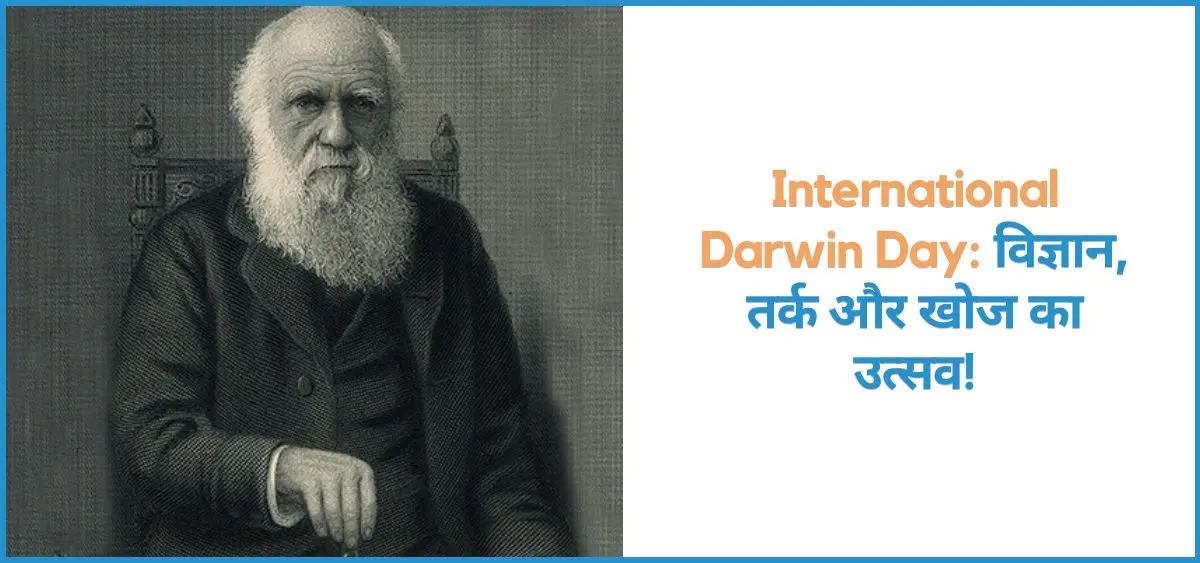
History, Significance, and Scientific Legacy of Darwin Day! | International Darwin Day | National Darwin Day
International Darwin Day is celebrated every year on February 12th, a special commemoration of Charles Darwin’s birthday. Whether you are a seasoned scientist who doesn’t mind experimenting and getting their hands dirty, or if the ideas of mathematics and dissection intimidate you, on this day we celebrate the works of Charles Darwin and science in general. This day gives us a chance to reflect on his experiments, conclusions, and achievements, and to consider how they still impact our lives today. The discovery of the theory of evolution has inspired scientists in many fields to make life-changing and life-saving discoveries about our species and our origins. We owe a great deal of gratitude to Darwin and his research!

Darwin Day is celebrated worldwide, and its main objective is to highlight Darwin’s contributions to science and promote science. On this day, we not only remember Darwin’s life and work but also discuss the important role of science.
What is Darwin Day?
Darwin Day is a global celebration observed on February 12th in memory of Charles Darwin’s birthday. This day not only honors Darwin’s contributions but is also used to promote the advancement of science and the theory of evolution. People around the world organize lectures, exhibitions, discussions, and other activities on this day. Darwin, considered the father of natural selection, laid the foundation of biology with his works. The significance of this day is that it reminds us how science changes our understanding. For example, Darwin’s theories have revolutionized fields like medicine, agriculture, and environmental science. In simple terms, Darwin Day is a celebration for science enthusiasts that inspires us to understand the complexities of nature. This day also connects ordinary people with science so they can better understand the concept of evolution.
History of Darwin Day
Charles Darwin was born on February 12, 1809, into a wealthy family in England. He was the fifth of six children. His father was a physician and his grandfather a renowned naturalist, who laid the foundation for Darwin’s scientific interest. In 1825, Darwin entered medical school, but he found it dull and lost interest in studying. His father sent him to Christ’s College, Cambridge, to become an Anglican clergyman. Even while studying religion there, Darwin’s inclination turned towards natural science. A friend sparked his interest in beetle collecting, and he met other naturalists who fostered his interest. He planned a trip to the tropics with his professor to study natural history.
Upon his return, Darwin got the opportunity to join the HMS Beagle expedition to South America as a naturalist. Captain Robert FitzRoy was in command. This journey, which began in 1831, lasted five years. In South America, Darwin extensively studied geology, anthropology, zoology, and botany. He collected fossils, rocks, plants, and insects. Both Darwin and FitzRoy kept travel diaries, which remain important today. Upon returning to England, Darwin’s theory of evolution became a topic of discussion, especially the finches of the Galapagos Islands strengthened his ideas. He revised his journal, read Malthus’s works, and experimented with plants. During this period, he married but suffered from a chronic illness.
In 1859, Darwin published “On the Origin of Species,” which described natural selection. The book became popular, but the Church opposed it, believing in divine creation. Darwin continued his work for 22 years and died of heart disease in 1882, possibly from Chagas disease. The celebration of Darwin’s work began after his death. Events were held at Down House, where he lived from 1842. In 1909, more than 400 scientists gathered in Cambridge. The New York Academy of Sciences celebrated the 100th anniversary and unveiled a statue. The Royal Society in New Zealand organized ceremonies. In 1959, the University of Chicago held a large celebration. Events like “Phylum Feast” took place in Canada. In the United States, Salem State College started the “Darwin Festival” in 1980.
The Humanist Community of Palo Alto held its first event in 1995. The London Evolution Group started “Darwin’s Birthday Celebration” in 1994. In 1997, Professor Massimo Pigliucci at the University of Tennessee started an event. The London Evolution Group was formed in 1992, which continues today. Amanda Chesworth and Robert Stephens made efforts in the 1990s. In 2001, the “Darwin Day Program” was incorporated. A book was published in 2002. In 2004, “Darwin Day Celebration” was established. The website is now operated by the International Darwin Day Foundation. The University of Georgia, the Ethical Humanist Society of Long Island, and Southern Illinois University also celebrate. The Clergy Letter Project encourages Evolution Weekend.
Darwin Day Programs and Darwin Day Celebrations
Darwin Day programs include lectures, debates, and activities. The London Evolution Group started in 1994, which is now the “Darwin Birthday Debate.” Amanda Chesworth and Robert Stephens formed the organization in 2001. In 2002, the book “Darwin Day Collection One” was published. In 2004, a new organization was formed in California. The website was revamped for education and event registration, email support. It is now operated by the International Darwin Day Foundation (an autonomous program of the American Humanist Association). The University of Georgia has been celebrating since 2009. The Long Island Society holds programs for children and adults. Southern Illinois University has been celebrating Darwin Week since 2006. These programs promote science education and help counter creationism pressure.
- London Evolution Group (since 1992): Formed by evolutionary biologist James Mallet and systematist botanist Sandra Knapp. Initially a mailing list for evolutionary biologists in the London area. In 1994, the first “Darwin’s Birthday Celebration” was held at the Linnean Society of London (Piccadilly). The event included two speakers (sometimes on opposing sides), a Q&A session, and a reception. Today, it continues in collaboration with the Centre for Ecology and Evolution (CEE), with University College London, the Linnean Society, and the Natural History Museum as key partners. The current name is “Darwin Birthday Debate,” held at the Natural History Museum in February (e.g., on “The holobiont in evolution” in 2026). The spirit is still alive.
- Efforts by Amanda Chesworth and Robert Stephens (late 1990s): Enthusiastic fans of Darwin informally promoted Darwin Day. In 2001, Chesworth incorporated the “Darwin Day Program” in New Mexico. The board included Stephens (President), Massimo Pigliucci (Vice President), and Chesworth (Secretary/Executive Director). Stephens outlined the objectives in the article “Darwin Day: An International Celebration.”
- Book in 2002: Chesworth edited “Darwin Day Collection One: The Single Best Idea, Ever,” showcasing Darwin’s multifaceted reach and connection to popular culture.
- Organizational Change in 2004: The New Mexico corporation was dissolved, and “Darwin Day Celebration” (non-profit) was established in California. The website was revamped for education, event registration, and email support. It is now operated by the International Darwin Day Foundation (an autonomous program of the American Humanist Association).
- University of Georgia: Co-sponsored by Franklin College, Biological Sciences, Odum School of Ecology, etc. Mark Farmer (Professor/Organizer) started in 2009 (on the 150th anniversary of the Origin of Species and Darwin’s 200th birth anniversary). Celebrates Darwin’s impact through a lecture series.
- Long Island Ethical Humanist Society: Engaging programs for children and adults.
- Clergy Letter Project: Encourages pro-evolution churches to participate in “Evolution Weekend” (now Religion and Science Weekend) on the nearest Sunday.
- Southern Illinois University: Celebrates Darwin Day and Darwin Week since 2006 (starting with a speech by Tim Berra), featuring lectures and activities.
How to Celebrate Darwin Day?
Darwin Day is celebrated every year on February 12th to commemorate Charles Darwin’s birthday. This day is an opportunity to celebrate his theory of evolution and contributions to science. It can be celebrated in simple and fun ways at home, school, or in the community. Here are some easy and effective ways:
- Read or Discuss Darwin’s Book Read the main points of “On the Origin of Species” or discuss evolution with family/friends. Start with simple books or videos, such as watching documentaries about the finches of the Galapagos Islands. This enhances scientific understanding.
- Spread Awareness on Social Media Post with the hashtag #DarwinDay. Share interesting facts about Darwin, quotes, or images of his theory. This promotes science and helps people learn about evolution.
- Organize a Phylum Feast or Themed Meal Create dishes inspired by different animal phyla, such as dishes with flavors of various animals. This is a fun tradition dating back to the 1970s, showcasing the diversity of evolution.
- Hold Lectures, Games, or Crafts Give a small lecture at home or play games like “Pin the Tail on the Finch.” For children, create Candy Evolution or Mixed Animals crafts, where they design new creatures by combining animal parts.
- Visit a Zoo or Go on a Nature Walk Go to a zoo to see evidence of evolution, such as the adaptability of different species. Or observe nature in a local park and take notes.
- Host a Birthday Party Cut a cake for Darwin, make birthday cards, or have a “Happy Birthday Darwin” themed party. Invite friends and discuss science.
5 Interesting Facts About Charles Darwin
- He suffered from chronic illness. It is believed that excessive work caused fatigue, nausea, headaches, and heart palpitations. Possibly Chagas disease.
- Darwin was born on the same day as Abraham Lincoln. Both were born on February 12, 1809, one in a log cabin, the other in a mansion.
- He decided to marry based on a pros and cons list. He decided to marry his cousin Emma using this method.
- The theory of “survival of the fittest” is not Darwin’s. It belongs to Herbert Spencer, who linked it to economic theories.
- Darwin ate exotic animals for breakfast. During his travels, he ate ostriches, pumas, and armadillos.
Why is Darwin Day Important?
Darwin Day is not limited to remembering Darwin. It celebrates science, especially considering the contributions of biologists. Darwin laid the foundation of evolution, on which other scientists built further work. It is an opportunity to refresh knowledge of biology. Many people forget science after school; this day ignites enthusiasm in zoology and botany. It is important history. Darwin made history when scientific knowledge was scarce. This day offers a chance to look at 19th-century science. Overall, it inspires us to enhance our understanding of nature and life.
The Theory of Evolution
Darwin’s theory of evolution states that all life on Earth is interconnected, forming what is called a phylogenetic tree. Species diversity arises from natural selection. More diverse species emerge, but only the adapted ones survive. “Survival of the fittest” is often misunderstood; it means being fit for specific conditions, passing genes to the next generation. Gradually, new species evolve through mutations. This theory is the foundation of biology and impacts fields from medicine to environmental science.
Conclusion: International Darwin Day February 12
Darwin Day is not just an occasion to remember Charles Darwin; it is also a day to understand the importance of science, logic, and independent thought. Darwin’s theory of evolution gave new direction to human life, biology, medicine, and environmental understanding. He proved that nature is constantly changing and life progresses through adaptation. Darwin Day inspires us to ask questions, seek evidence, and adopt a scientific perspective, rising above superstition. This day symbolizes the celebration of knowledge, humanism, and scientific consciousness.
Related Articles:–